> ## Documentation Index
> Fetch the complete documentation index at: https://help.experro.com/llms.txt
> Use this file to discover all available pages before exploring further.
# Target Audience
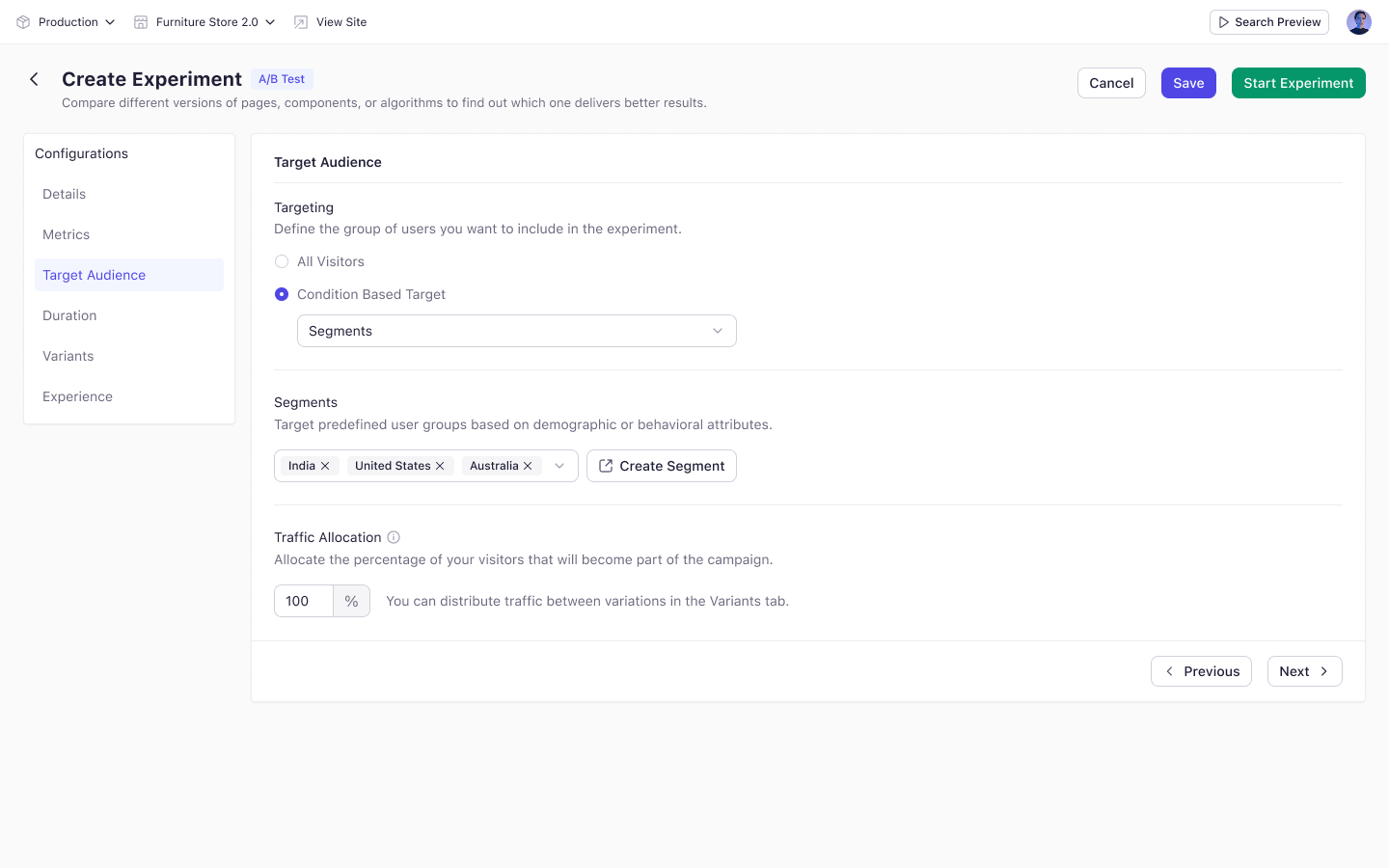
Target Audience controls entry to the experiment. It answers two separate questions: who is eligible, and how many of the eligible actually take part.
## Targeting
Choose one of two options.
**All Visitors** makes every visitor eligible. This is the default and the right choice for most tests.
**Condition Based Target** narrows eligibility using audience segments, UTM parameters, locations, or device types. See [Condition Based Targeting](/experiments/targeting/condition_based_targeting).
## Traffic Allocation
Traffic allocation sets the percentage of eligible visitors who enter the experiment, from 1 to 100. It defaults to 100.
Lower it when you want to limit exposure — a risky change might start at 10% while you watch for problems.
 ## How Targeting and Allocation Combine
The two settings apply in order. Targeting runs first and produces the eligible pool. Traffic allocation then takes a percentage of that pool.
Suppose 1,000 visitors arrive:
1. Targeting restricts the experiment to US visitors, leaving 500 eligible.
2. Traffic allocation is set to 50%, so 250 visitors enter the experiment.
3. Those 250 are then split across the control group and variants on the **Variants** step.
The remaining 750 visitors never enter the experiment and see your live experience.
Traffic allocation on this step controls entry to the experiment. The split between the control group and each variant is set separately on the **Variants** step.
## Key Considerations
* Values of zero or below are corrected to 1.
* Narrow targeting reduces the traffic reaching your test, which lengthens the time needed for a reliable result.
## What's Next
* [Condition Based Targeting](/experiments/targeting/condition_based_targeting)
* [Duration](/experiments/a_b_testing/duration)
## How Targeting and Allocation Combine
The two settings apply in order. Targeting runs first and produces the eligible pool. Traffic allocation then takes a percentage of that pool.
Suppose 1,000 visitors arrive:
1. Targeting restricts the experiment to US visitors, leaving 500 eligible.
2. Traffic allocation is set to 50%, so 250 visitors enter the experiment.
3. Those 250 are then split across the control group and variants on the **Variants** step.
The remaining 750 visitors never enter the experiment and see your live experience.
Traffic allocation on this step controls entry to the experiment. The split between the control group and each variant is set separately on the **Variants** step.
## Key Considerations
* Values of zero or below are corrected to 1.
* Narrow targeting reduces the traffic reaching your test, which lengthens the time needed for a reliable result.
## What's Next
* [Condition Based Targeting](/experiments/targeting/condition_based_targeting)
* [Duration](/experiments/a_b_testing/duration)